
Gopal Midha
There is in the act of preparing, the moment you start caring. – Winston Churchill
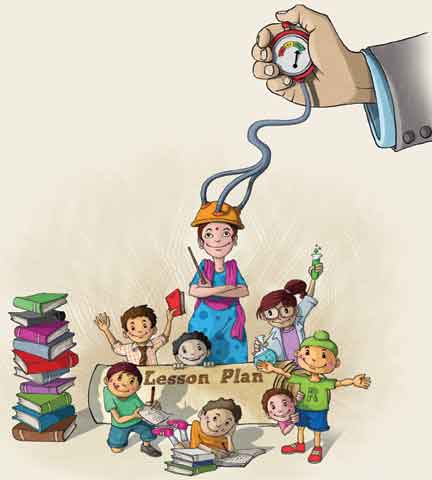 Lesson plans are an important teaching-planning aid used by everyone academically linked to schools. The teacher uses them to decide how classroom sessions will proceed and how best to guide student learning. The principal or the headmaster refers to them to see if the teachers are planning well and are on track to cover the curriculum. Classroom observers watch the teacher in action and compare her class against her lesson plan. Visiting inspectors from examination boards consider them as proof of sound classroom practices. It seems that we cannot imagine schools without lesson plans.
But where does this idea of lesson plans come from? Who proposed it? Are all lesson plan formats alike or do teachers follow different kinds of lesson plan formats? Are they all effective? What does the commonly used Objectives-Activities-Assessment lesson plan format say about how students learn? Does using scripted/readymade lesson plans help or hinder the teacher? Finally, how can the school and the teacher improve planning for classroom sessions?
In this article, I explore these questions based on the research studies1 I have come across and my own experience as a teacher.
Lesson plans: a brief history
Ralph Tyler was the first to propose an “effective organization of educational experiences to achieve the educational purpose of the school”2. He suggested that a good lesson plan should be able to:
a) specify objectives
b) select learning activities
c) organize the learning activities, and
d) identify evaluation procedures (Doyle & Holm, 1998)3.
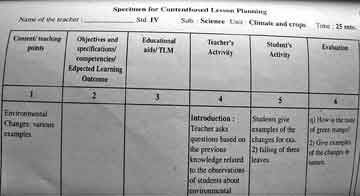
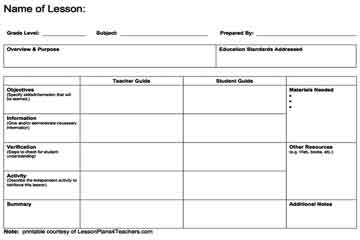
Although proposed in 1949, teacher-educators teach this approach in teacher preparation institutions even today (see image 1 of a specimen lesson plan from the 2006-07 Diploma in Teacher Education Source book, Maharashtra). Lesson plan formats available on the web are similar too (see image 2). Even though researchers like Bloom (1956)4 have contributed to this model with extended taxonomies, or like Jones, et al (2009)5 have proposed different sequences, most lesson plans are likely to have the following sections:
1. Learning objectives
2. Teaching and learning materials required
3. Activities for the teacher and the student
4. Assessment
5. Plenary
We may call this the Objectives-Activities-Assessment (OAA) format. Let us examine what this format assumes about the nature of teaching and learning.
The OAA model and its assumptions about learning
This model is linear. In other words, it assumes that learning can be structured in a way such that the objectives will clearly lead to designing learning activities and these activities can be assessed to see whether the objectives are met. The lesson plan format does not provide room for a more realistic and complex approach to learning. Classroom learning emerges from the dialogue and reflection between the teacher and her students. A linear lesson plan goes against this interactive and emergent nature of learning. It does not highlight the possibility of, or provide space for back-tracking, checking student misperceptions and other possible pathways.
Koeller & Thompson (1980)6 argue that this format “creates a split between the means (activities) and the ends (objectives) of learning.” This separation of the objectives and activities makes them seem as successive steps to learning rather than as part of a whole (John, 2006)7. Since the objectives and activities are written in separate unrelated rows, the teacher finds it hard to imagine how sometimes learning is “situated” and embedded within the activity and the context as proposed by Brown, Collins & Duguid (1989)8.
Researchers like John (2006) and Smith (1996)9 claim that the format is behaviourist. It breaks down learning into a set of tasks/activities/competencies, which can be observed and assessed. There are lesson plans that force the teacher to write details, such as which student will do exactly what during the session – creating a blueprint, which presumably will turn into reality in the classroom. Some lesson plans also ask the teacher to label students as “gifted and talented” or as “slow-learners” based on their display of competencies in the classroom. Such categories often link intelligence with the speed of response rather than its depth (Duckworth, 1996)10 and can have a negative impact on the students and their belief in their own competence.
The model also assumes universal impact. Irrespective of the social and cultural background of the students, it supposes that all students will learn the same thing from a given learning activity. Fosnot (1966)11 describes constructivist learning as learners physically, symbolically, socially, and theoretically constructing their knowledge. Knowledge is not something handed down to them, rather the students create their own conceptual understanding of a topic. The lesson plan format often ignores this active and individualized knowledge gathering by the learner and assumes that all learners will “build” knowledge in the same way. Hence, the role of the teacher becomes more like that of a technician who is efficient at delivering the content in the lesson plan.
The format also believes that setting objectives precedes learning activities and experiences. However, there is a wide diversity in the way teachers prepare lesson plans. In my experience, some teachers prefer to begin with learning activities and then tie in the objectives while some prefer to fill up the objectives and then think of activities and so on. Whatever approach a teacher takes, John, (2006 p. 490) states that the lesson plan is often “arrived at through a variety of processes, many of which are highly personal, idiosyncratic, and embedded in the subject and classroom context of the topic being planned.”
Hence, we need to examine lesson plan formats carefully by questioning their underlying assumptions about the teacher, the student and the learning process. If these assumptions go against how students learn and how teachers think and plan, then the lesson plan might actually hinder the learning process.
Designing and delivering the lesson plan
Is there a link between the quality of a lesson plan and its delivery? Does a well-articulated lesson plan always lead to an effective classroom session? Since teachers are usually pressed for time, there have been well-intentioned efforts to introduce scripted12 lesson plans to reduce the time teachers take for making lesson plans. Another unstated assumption is that such a lesson plan will give confidence and a sense of direction to the teacher. Although studies like those of Dorovolomo et al (2010)13 highlight that the quality of lesson plans prepared by teachers is positively linked to its quality of delivery, they do not prove whether a quality lesson plan given to teachers will be beneficial for students and classroom interactions.
Further, the same lesson plan will be carried out differently by different teachers. Hence, it will never be implemented the way it was imagined by the “expert” lesson planner. The dynamic nature of the classroom usually frustrates a linear planned pathway. Besides, a teacher might not “own” a readymade lesson plan the same way she does a lesson plan made by her.
Hence, a well-crafted lesson plan may provide some sense of direction and confidence to a teacher, however, the complexity of the classroom will make such confidence short-lived. It also undermines their planning. The scripted lesson plan instead of being a scaffold may actually become an obstacle preventing the teacher from developing her planning skills besides challenging her competence.
 Lesson planning – a forgotten phase that needs more support
Lesson plans are also used to inspect and assess teaching quality within the classroom. They are mandatory under certain examination boards and are subject to audit. Hence, teachers fill up lesson plans not just as an academic requirement but also as an administrative duty and most schools have policies mandating lesson plans to be filed well in time.
However, there are few policies that support or guide the teacher in the process of lesson planning. Although schools may provide time to the teachers to plan their lessons, they do not support them actively in developing a richer understanding of the planning process and reflection after classroom sessions. Most teachers, therefore, make lesson plans, conduct their sessions and get busy with preparing the next plan – spending little time on discussion and reflection.
Consequently, novice and experienced teachers might begin to view lesson plans as more of an administrative task than something that could help guide their teaching.
What can we therefore do? – Indicative guidelines
So far, we have learnt a bit of the thinking behind lesson plans and the need for quality lesson planning. There is no “best-way” to plan, but certain guidelines may be useful. Some of them are outlined below:
- Importance of planning: Provide time and support to teachers for lesson planning. Schools need to look at the time that teachers spend on planning as at least as critical as the time teachers spend inside the classroom. The school can bring in subject experts to talk to teachers and work with them during the planning process. They could also provide access to books on the nature of subjects, how to teach them or on how such subjects are actualized outside school.
- Critical review: Discuss the lesson planning format. Teachers need to critically examine the lesson plan format they use. As a tool, the lesson plan is not merely an output of a teacher’s thinking, it shapes the way the teacher thinks and plans. Teachers could work together to modify the format and review it periodically. For instance, a section on hypotheses about what students are likely to know and how the plan builds on that could be useful. Adding a short checklist on meta-questions about the lesson plan format itself could be tried out.
- Reflective practice: Use the lesson plan to discuss what happened in the classroom. Teachers could either take turns to describe how the classroom sessions progressed compared to their plans and become aware of the decisions they took and what other instructional strategies they could have used. Using video for self-reflection on the lesson plan could support those teachers who are more comfortable analyzing their sessions on their own. Further, teachers could use the lesson plan as a useful artifact to reflect on how students learn.
- Diversity in design and delivery: The school could reduce the importance of sticking to a standard lesson plan and accept that teachers will follow different strategies in designing and delivering lesson plans. Principals and inspectors should not use the lesson plan to judge the teacher, but rather as a tool that helps teachers visualize and imagine how the classroom session will take place.
- Work with others: Borrowing from and adapting the Japanese method of lesson study14, teachers could work together to draw up detailed lesson plans, deliver them and discuss them as a group to answer research questions (the group of teacher defines their own research questions and then does lesson study to answer them).
Summarizing the answers/findings
To conclude, lesson planning, like teaching-learning, is complex and requires interacting with factors like the knowledge of the teacher, the nature of the subject, the teacher’s beliefs about the subject and its pedagogy, the socio-cultural context of the classroom and the lesson plan format. However, when lesson planning is treated sincerely and done thoughtfully, it can lead to a richness of learning within the classroom and provide intense, fulfilling and powerful learning experiences to teachers and students.
I hope this article leads to discussions on the nature of lesson plans, the quality and time spent on lesson planning and on questions like:
- Do different subjects need different kinds of lesson plan formats?
- What are the ways teachers could reflect on their lesson plans after the classroom session?
- What is the role that students and parents could play in designing a lesson plan?
- What about processes like lesson study? How can they work in schools here?
___________________________________________________________________________________
References
- At times, I have summarized the findings of the research and not elaborated them. I do hope that this encourages teachers and other readers to go to the original research article and engage in the demanding, yet fulfilling task of developing a richer understanding of the reference.
- Tyler, R. W. (1949). Basic Principles of Curriculum and Instruction. Chicago: University of Chicago. Also read Bobitt’s work which brought up the education objectives approach. Bobbitt, F. (1928). How to Make a Curriculum, Boston: Houghton Mifflin. As the reader might observe, these books are more than half a century old. It makes me wonder on how much they still influence current thinking and whether that is good.
- Doyle, M. & Holm, D.T. (1998). Instructional Planning through Stories. Teacher Education Quarterly 25(3), 69-83.
- Bloom, B. S. (Ed.). (1956). Taxonomy of educational objectives: The classification of educational objectives by a committee of college and university examiners. Handbook 1: Cognitive Domain. New York: D. McKay.
- Jones, K.A., Vermette, P.J. & Jones, J.L. (2009). An Integration of “Backwards Planning” Unit Design with the Two-Step Lesson Planning Framework. Education. 130(2). 357-360.
- Koeller, S. & Thompson, E. (1980). Another look at Lesson Planning. Educational Leadership. 673-675.
- John, P. D. (2006). Lesson planning and the student teacher: re-thinking the dominant model. Journal Of Curriculum Studies, 38(4), 483-498.
- Brown, J.S., Collins, A. and Duguid, P. (1989). Situated Cognition and the Culture of Learning. Educational Researcher. 18(1), 32-42. This remains one of the most influential and debated articles on how people learn. If there is one article that you have time to engage with, this is the one I would recommend.
- Smith, M. K. (1996, 2000) ‘Curriculum theory and practice’ the encyclopedia of informal education, Retrieved November 12, 2011 from www.infed.org/biblio/b-curric.htm.
- Duckworth, E. (1996). The Having of Wonderful Ideas and other essays. NY: Teachers College Press.
- Fosnot, Catherine. (1996). Constructivism: Theory, perspectives, and practice. New York: Teachers College Press.
- By scripted, I mean those ready-made lesson plans which detail out the objectives and learning activities and leave little room for the teacher to decide about what will be taught and how.
- Dorovolomo, J., Phan, P. H. & Maebuta, J. (2010). Quality Lesson Planning and Quality Delivery: Do they relate? International Journal of Learning. 17(3), 447-455.
- “What is lesson study?” (N.A.) Retrieved November 11, 2011 from http://www.tc.columbia.edu/lessonstudy/lessonstudy.html.
The author is an education consultant with Tata Institute of Social Sciences, Mumbai. He holds an MBA from IIM Lucknow and an M.Ed from the University of Massachusetts. He can be reached at gopalmidha@gmail.com.